Baltimore, MD Clinical Trials Report — July 2026
19 New Studies, 86 Closing Soon
Hipa.ai Research - July 1, 2026 - Source: Hipa.ai, ClinicalTrials.gov
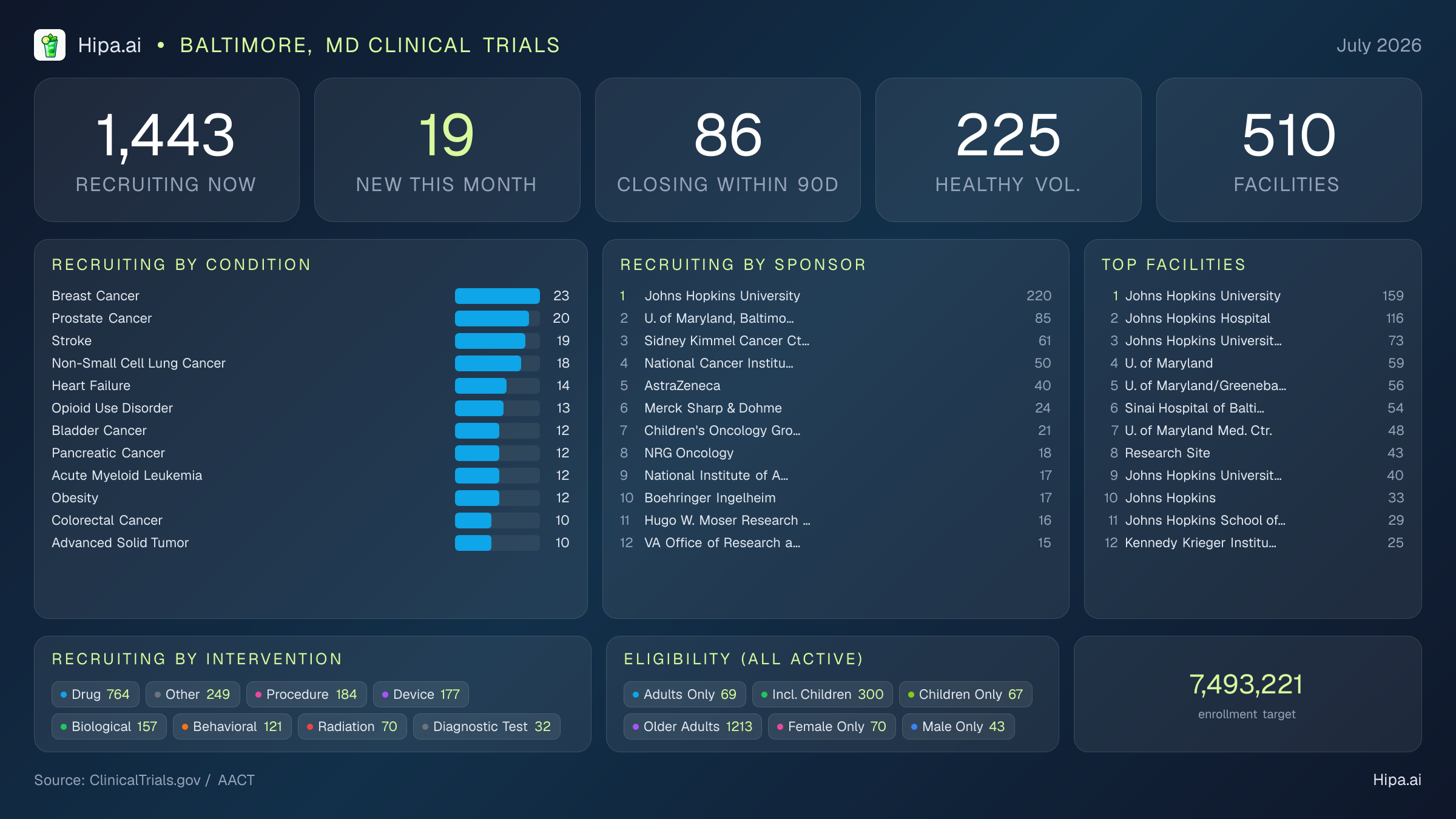
Baltimore participants should act quickly if they match a closing study: 86 recruiting trials are expected to close within the next 90 days, including 21 that accept healthy volunteers. The largest groups of closing studies involve breast cancer, stroke, and prostate cancer, with 4 trials each. Baltimore currently has 1,443 recruiting trials across 510 research facilities.
July brought 19 new trials, down from 24 in June and 24 in May. That continues a gradual decline from 24 new trials in February, 22 in March, and 23 in April. Despite the slower pace of new openings, Baltimore remains a major Maryland research center, with especially broad opportunities through Johns Hopkins and the University of Maryland.
Closing windows for Baltimore patients and volunteers
Projected closing dates are not guarantees: a study can stop enrolling earlier if it reaches its participant target. People with relevant diagnoses should review eligibility and contact study teams now, especially in the most active closing categories:
- Breast cancer (4 trials)
- Stroke (4 trials)
- Prostate cancer (4 trials)
- Multiple myeloma (2 trials)
- Acute pain (2 trials)
- Pancreatic cancer (2 trials)
- HIV (2 trials)
- Cystic fibrosis-related diabetes (2 trials)
- Head and neck squamous cell carcinoma (2 trials)
- Alzheimer disease (2 trials)
Healthy volunteers have a substantial local pool to consider: 225 healthy-volunteer trials are recruiting in Baltimore overall, and 5 of the 19 July openings accept healthy volunteers. Because 21 closing-soon studies also accept healthy participants, people without a diagnosed condition should check screening requirements soon. Studies may still limit enrollment by age, medications, health history, or time commitment.
New Phase 3 and large-scale studies
Drug studies led Baltimore’s new openings with 9 trials, followed by 7 categorized as other, 4 device studies, 2 biological studies, and one each involving behavioral and radiation research. The month’s notable late-stage and large-enrollment opportunities include:
- NCT07680790, Bristol-Myers Squibb’s Phase 3 IZABRIGHT-Lung02 study, is evaluating izalontamab brengitecan with osimertinib against osimertinib alone or osimertinib plus platinum-based chemotherapy for previously untreated EGFR-mutant non-small cell lung cancer. Planned enrollment is 850 participants.
- NCT07679282 is a Phase 4 comparative study of positive airway pressure, a dental device, and atomoxetine-oxybutynin for obstructive sleep apnea in adults. Sponsored by Sairam Parthasarathy, the study plans to enroll 2,400 participants.
- NCT07728123, Screen2Prevent, is sponsored by Westat and will evaluate three broad HIV screening approaches in emergency departments: targeted screening, universally offered opt-in screening, and universally offered opt-out screening. The study lists 84,000 participants.
- NCT07737535, sponsored by Johns Hopkins University, examines inflammatory arthritis that develops after immune checkpoint inhibitor treatment. The study plans to enroll 1,000 participants and will investigate disease development, progression, and treatment response.
- NCT07696338, the REACT study, evaluates early airway-clearance therapies for people with cystic fibrosis, including hypertonic saline and dornase alfa. It is sponsored by Nicole Hamblett and plans to enroll 405 participants.
- NCT07685977, ARTEMIS, is a multicenter randomized study sponsored by Vanderbilt University Medical Center. It examines whether rapid onsite evaluation during robotic bronchoscopy improves diagnostic performance and next-generation sequencing results, with 400 planned participants.
New conditions represented this month include Alzheimer’s disease, acute myeloid leukemia, central centrifugal cicatricial alopecia, chronic pain, cutaneous T-cell lymphoma, cystic fibrosis, dental implant healing, hepatocellular carcinoma, and HIV infections. Johns Hopkins University sponsors 4 new studies, while the University of Maryland, Baltimore sponsors 3. Bristol-Myers Squibb sponsors 2. The overall July mix includes 11 studies categorized as other, 6 industry-sponsored studies, and 2 NIH studies, including work from NIAID and the National Institute on Aging.
Where Baltimore has the most research activity
Johns Hopkins-affiliated locations account for the largest concentration of recruiting studies in the city, spanning cancer, neurology, infectious disease, respiratory conditions, and many other specialties. University of Maryland sites provide another major cluster, particularly for cancer and hospital-based research. Participants should confirm the exact location, specialty, and study status with each research team before traveling.
- Johns Hopkins University (159 trials)
- Johns Hopkins Hospital (116 trials)
- Johns Hopkins University/Sidney Kimmel Cancer Center (73 trials)
- University of Maryland (59 trials)
- University of Maryland/Greenebaum Cancer Center (56 trials)
- Sinai Hospital of Baltimore (54 trials)
- University of Maryland Medical Center (48 trials)
- Research Site (43 trials)
- Johns Hopkins University School of Medicine (40 trials)
- Johns Hopkins (33 trials)
- Johns Hopkins School of Medicine (29 trials)
- Kennedy Krieger Institute (25 trials)
Three July studies include children, and 16 include older adults. No new trial is designated female-only or male-only. Families should pay close attention to pediatric age ranges, while older adults may find opportunities across cancer, Alzheimer disease, respiratory, and other research areas.
Other Maryland cities to consider
Participants able to travel can also search nearby Maryland locations. Bethesda has 10 recruiting trials, the largest reported nearby option. Additional opportunities are listed in Brooklyn, Columbia, Gaithersburg, Salisbury, Silver Spring, and Wheaton, with 1 trial in each city. Availability and eligibility can differ substantially between locations, so broaden searches only after confirming travel requirements and site contacts.
With a large active portfolio, a strong academic-site presence, and dozens of studies approaching their projected end dates, Baltimore’s next few months may shift the local balance quickly. Patients and healthy volunteers who qualify should begin screening conversations now while July openings and closing-soon opportunities remain available.
Data Highlights
Conditions Closing Soon
- breast cancer (4)
- stroke (4)
- prostate cancer (4)
- multiple myeloma (2)
- acute pain (2)
- pancreatic cancer (2)
- hiv (2)
- cystic fibrosis-related diabetes (2)
Most Common New Trial Conditions
- alzheimer's disease (1)
- aml (1)
- central centrifugal cicatricial alopecia (ccca) (1)
- chronic pain (1)
- chronic pain syndrome (1)
- cutaneous t-cell lymphoma (1)
- cystic fibrosis (cf) (1)
- dental implant healing (1)
Cities With the Most New Trials
- Bethesda (10)
- Brooklyn (1)
- Columbia (1)
- Gaithersburg (1)
- Salisbury (1)
- Silver Spring (1)
- Wheaton (1)
Leading Sponsors
- Johns Hopkins University (4)
- University of Maryland, Baltimore (3)
- Bristol-Myers Squibb (2)
- National Institute of Allergy and Infectious Diseases (NIAID) (1)
- National Institute on Aging (NIA) (1)
- Nicole Hamblett (1)
- Sairam Parthasarathy (1)
- SecuraBio (1)
| Month | New Trials | Closing Soon |
|---|---|---|
| March 2026 | 22 | 2 |
| April 2026 | 23 | 2 |
| May 2026 | 20 | 11 |
| June 2026 | 24 | 16 |
| July 2026 | 19 | 10 |
| August 2026 | 3 | 0 |
New Studies This Month (19)
Top Research Facilities in Baltimore
These research sites are running the most clinical trials in Baltimore, Maryland.
More Clinical Trials in Maryland
Other City Research Reports in Maryland
Compare the July 2026 clinical trials report for Baltimore with other Maryland cities.
Ready to participate?
Browse every recruiting paid clinical trial in Baltimore, MD, filter by condition, age, and healthy-volunteer status, and jump directly to each study to apply.
Browse Paid Clinical Trials in Baltimore