North Carolina Clinical Trials Report — July 2026
39 New Studies, 141 Closing Soon
Hipa.ai Research - July 1, 2026 - Source: Hipa.ai, ClinicalTrials.gov
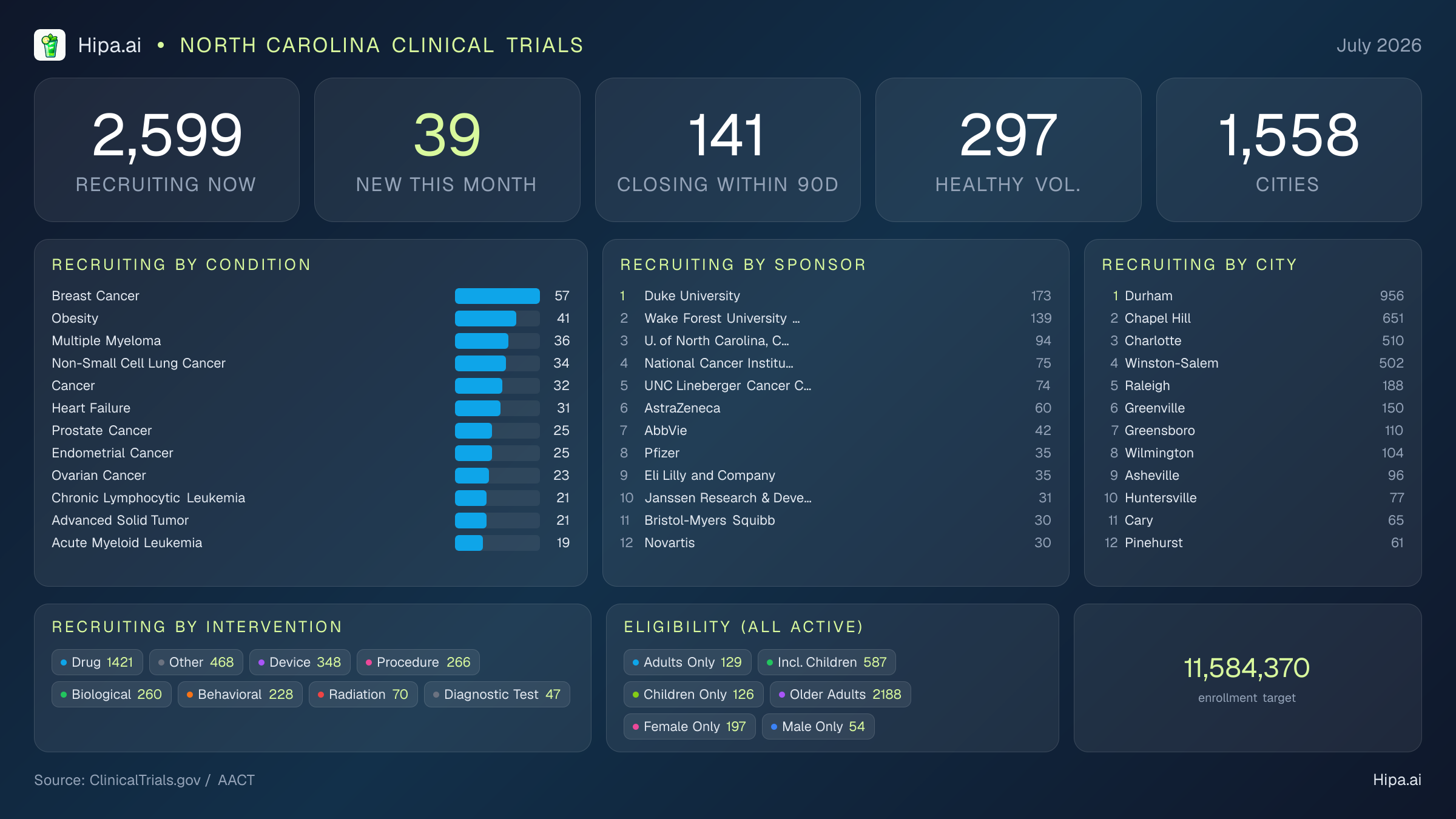
North Carolina residents considering a clinical trial should check eligibility soon: 141 recruiting studies are expected to close within the next 90 days. Of those, 31 accept healthy volunteers. Enrollment can end before a projected closing date, and screening may take time, so people who match a study should contact the research site now rather than wait.
The state has 2,599 recruiting trials across 97 cities and 1,558 research sites. July brought 39 new studies, fewer than the 54 that opened in June and the 61 reported in May. Even with the slowdown, North Carolina continues to offer a broad mix of drug, behavioral, device, and university-led research.
Closing-soon studies create the most immediate openings
Cancer-related trials make up the largest groups approaching closure. Breast cancer, prostate cancer, and cancer studies overall each account for 4 closing-soon trials. Head and neck cancer and lung cancer follow with 2 each, as do colorectal cancer, major depressive disorder, asthma, anterior cruciate ligament injuries, and chronic kidney disease.
- Breast cancer — 4 closing-soon trials
- Prostate cancer — 4
- Cancer overall — 4
- Major depressive disorder, head and neck cancer, lung cancer, colorectal cancer, asthma, anterior cruciate ligament injuries, and chronic kidney disease — 2 each
Healthy adults also have a time-sensitive opportunity. Thirty-one of the studies nearing closure accept healthy volunteers, while 297 healthy-volunteer trials are recruiting statewide overall. People without a diagnosed condition should review eligibility promptly, particularly if they are willing to participate in behavioral, prevention, device, or other non-treatment research.
July brings major Phase 3 studies in weight management and cancer
New trials opened in a range of conditions, led by overweight and obesity with 2 studies each and breast cancer with 2. Other new areas included acute otitis media, Alzheimer’s disease, acute myeloid leukemia, aging, anterior cruciate ligament tears, and atopic dermatitis or eczema.
Drug studies were the most common type, with 19 of the 39 new trials. Other intervention categories included 9 studies classified as other, 8 behavioral studies, 5 device trials, 2 biological studies, and 2 procedure trials. Six new trials accept healthy volunteers. Five include children, three are female-only, two are male-only, and 28 include older adults in their eligibility criteria.
- NCT07684235 — Amgen’s Phase 3 MARITIME-1-EXTENSION study of maridebart cafraglutide for people with obesity or overweight. The extension plans to enroll 3,200 participants and evaluates long-term efficacy, safety, and tolerability.
- NCT07720271 — Novo Nordisk’s Phase 3 AMAZE 9 study of once-daily zenagamtide tablets for excess body weight, with planned enrollment of 950 participants.
- NCT07680790 — Bristol-Myers Squibb’s Phase 3 IZABRIGHT-Lung02 study comparing izalontamab brengitecan combinations with osimertinib-based treatments in previously untreated EGFR-mutant non-small cell lung cancer. The study plans to enroll 850 participants.
- NCT07684820 — Expedition Therapeutics’ Phase 2 study of EXPD-101/FXS7553 versus placebo for COPD over 52 weeks, with 600 planned participants.
- NCT07730814 — Nader Shaikh’s Phase 4 comparison of treatments for acute otitis media in children, enrolling 1,100 participants across hospitals and clinics.
- NCT07701161 — Neurogen Biomarking LLC’s study of a home Tasso lancet blood test for measuring p-tau217 in people with and without Alzheimer’s disease, including participants with confirmed amyloid pathology.
The Amgen and Novo Nordisk studies may attract particular attention from people seeking investigational oral or injectable approaches to excess weight, while the Bristol-Myers Squibb trial offers a major Phase 3 option for eligible people with EGFR-mutant lung cancer. These studies have specific medical and treatment-history requirements, so prospective participants should discuss the criteria with the recruiting site.
Universities and public researchers remain central to the pipeline
North Carolina’s academic centers opened many of July’s studies. Duke University sponsored 8 new trials, while the University of North Carolina, Chapel Hill, and Wake Forest University Health Sciences sponsored 4 each. Nader Shaikh sponsored two studies, including the pediatric ear- and sinus-infection research.
UNC Chapel Hill is also sponsoring NCT07699198, an online study testing cannabis warning messages. It plans to enroll 1,500 adults living in the United States, including people who use cannabis and people who do not. Because participation is online and does not require a cannabis-related diagnosis, it may be relevant to a wider group than site-based treatment studies.
Across sponsor categories, 25 new studies were classified as other, 12 were industry-sponsored, one was federally sponsored, and one was classified under NIH. Other named sponsors included High Point University, Inmagene LLC, and the National Institute of Allergy and Infectious Diseases.
The Triangle leads, with opportunities in Charlotte and beyond
New study activity is concentrated in North Carolina’s major research and medical centers. Durham led July’s openings with 15 new trials, followed by Chapel Hill with 9. Winston-Salem and Charlotte each added 5. Shelby and Raleigh recorded 2 each, while Research Triangle Park, Salisbury, Wilmington, and a listing recorded as Winstom Salem each had one.
- Durham — 15 new trials
- Chapel Hill — 9
- Winston-Salem and Charlotte — 5 each
- Shelby and Raleigh — 2 each
- Research Triangle Park, Salisbury, Wilmington, and Winstom Salem — 1 each
The pattern reflects a strong Research Triangle concentration, supported by Duke, UNC, and nearby research infrastructure. However, Charlotte, Winston-Salem, Shelby, Raleigh, Salisbury, and Wilmington also appear in the new-trial distribution. Residents should search by both condition and travel distance because a study’s total enrollment may be national while only one or two North Carolina sites are recruiting.
Who should act now?
People with breast, prostate, lung, head and neck, colorectal, or other cancers should review closing-soon listings first. Adults with asthma, chronic kidney disease, depression, or ACL injuries may also find studies approaching an enrollment deadline. Healthy volunteers should focus on the 31 closing studies that accept them, as well as the six new July studies open to healthy participants.
Parents may find new opportunities in pediatric research, including the Phase 4 acute otitis media and acute sinusitis studies. Older adults are represented broadly: 28 of July’s new trials include older adults, spanning Alzheimer’s research, chronic disease, cancer, and other areas.
North Carolina’s monthly opening count has varied during 2026, from 57 trials in February to 61 in May, then falling to 39 in July. The trend data also lists 15 new trials for August, suggesting that the pace may remain uneven. As enrollment windows shift through late summer, checking listings regularly and beginning screening early will give eligible patients and volunteers the best chance to participate.
Data Highlights
Conditions Closing Soon
- breast cancer (4)
- prostate cancer (4)
- cancer (4)
- major depressive disorder (2)
- head and neck cancer (2)
- lung cancer (2)
- colorectal cancer (2)
- asthma (2)
Most Common New Trial Conditions
- overweight (2)
- obesity (2)
- breast cancer (2)
- acute otitis media (aom) (1)
- alzheimer s disease (1)
- aml (1)
- aging (1)
- anterior cruciate ligament tear (1)
Cities With the Most New Trials
- Durham (15)
- Chapel Hill (9)
- Winston-Salem (5)
- Charlotte (5)
- Shelby (2)
- Raleigh (2)
- Research Triangle Park (1)
- Salisbury (1)
Leading Sponsors
- Duke University (8)
- University of North Carolina, Chapel Hill (4)
- Wake Forest University Health Sciences (4)
- Nader Shaikh (2)
- Expedition Therapeutics, Inc (1)
- High Point University (1)
- Inmagene LLC (1)
- National Institute of Allergy and Infectious Diseases (NIAID) (1)
| Month | New Trials | Closing Soon |
|---|---|---|
| March 2026 | 59 | 11 |
| April 2026 | 57 | 17 |
| May 2026 | 61 | 22 |
| June 2026 | 54 | 45 |
| July 2026 | 39 | 26 |
| August 2026 | 15 | 0 |
New Studies This Month (39)
City-Level Research Reports for North Carolina
Read the July 2026 clinical trials report for these North Carolina cities.
Top Cities for Paid Clinical Trials in North Carolina
Browse every recruiting paid clinical trial in the cities with the most active studies in North Carolina.
Ready to participate?
Browse every recruiting paid clinical trial in North Carolina, filter by condition, age, and healthy-volunteer status, and jump directly to each study to apply.
Browse Paid Clinical Trials in North Carolina